6. Production-ready authentication
You have a working authenticated request and a credential-management pattern that keeps secrets off disk and out of Git. Production adds three more requirements: know instantly when a key is missing or wrong, respond to rate limits without giving up, and package the whole thing so the next API you integrate doesn't start from scratch. This section covers all three.
The three status codes to recognise
Three HTTP response codes show up far more often once you're making authenticated requests. The traceback will include one of these numbers before it includes anything about your data, so it's worth knowing what each one is telling you:
| Code | Name | What it means | How to fix |
|---|---|---|---|
| 401 | Unauthorized | The server doesn't know who you are. Credentials are missing, wrong, or expired. | Check your key is spelled correctly, activated, and actually in the environment. Generate a new one if in doubt. |
| 403 | Forbidden | The server knows who you are, but this operation isn't allowed on your key. | Check your plan tier, your key's permissions, whether the feature needs a paid plan. |
| 429 | Too Many Requests | You've hit a rate limit. The server is blocking you temporarily to protect itself. | Wait (check the Retry-After header), slow your code down, or upgrade your tier. |
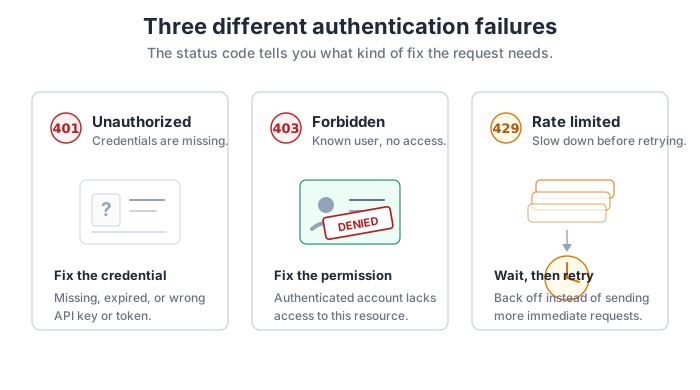
Two of these three (401 and 403) mean "don't retry, fix something first". The third (429) means "wait, then retry, politely". Getting that distinction right is most of what separates hobby-grade code from code you'd ship.
Validating credentials at startup
The best time to discover a missing key is on line one, not ten minutes in when the first API call fails mid-batch. Production code runs a credential check before any real work begins, so configuration errors surface immediately with a specific message and a non-zero exit code. Save this at the project root as startup_validator.py:
import os
import sys
from dotenv import load_dotenv

def validate_environment():
    """
    Validate all required environment variables at startup.
    Exit with clear error message if anything is missing or invalid.

    This runs before any API calls, preventing cryptic runtime errors.
    """
    load_dotenv()

    # Define all required variables
    required_vars = {
        "OPENWEATHER_API_KEY": {
            "description": "OpenWeatherMap API key",
            "min_length": 30,  # OpenWeatherMap keys are ~32 chars
            "where_to_get": "https://openweathermap.org/api"
        }
    }

    missing = []
    invalid = []

    # Check each required variable
    for var_name, config in required_vars.items():
        value = os.getenv(var_name)

        if value is None:
            missing.append((var_name, config))
        elif len(value) < config["min_length"]:
            invalid.append((var_name, config, f"too short (got {len(value)} chars)"))
        elif value in ["your_key_here", "replace_with_your_openweather_key", "REPLACE_ME"]:
            invalid.append((var_name, config, "still contains placeholder value"))

    # If any problems found, show helpful error and exit
    if missing or invalid:
        print("=" * 70)
        print("⚠️  CONFIGURATION ERROR: Missing or invalid environment variables")
        print("=" * 70)
        print()

        if missing:
            print("Missing variables:")
            for var_name, config in missing:
                print(f"  • {var_name}")
                print(f"    {config['description']}")
                print(f"    Get one at: {config['where_to_get']}")
                print()

        if invalid:
            print("Invalid variables:")
            for var_name, config, reason in invalid:
                print(f"  • {var_name}: {reason}")
                print(f"    {config['description']}")
                print()

        print("To fix:")
        print("  1. Copy .env.example to .env")
        print("  2. Fill in your actual API keys")
        print("  3. Run this script again")
        print()
        print("=" * 70)
        sys.exit(1)

    # All validations passed
    print("✓ All required environment variables are present and valid")
    return True

# Call at the very start of your program
if __name__ == "__main__":
    validate_environment()

    # Now it is safe for the rest of your program to start.
    print("Configuration valid. Ready to make authenticated API calls.")
The whole point of this function is to turn "why isn't my code working?" into "oh, I forgot to set up my .env file." One is a debugging session; the other is a fix you make in ten seconds. Three specific benefits fall out of running validation up-front: you learn about configuration problems in a second instead of after ten minutes of running, the error message tells you exactly what's missing and where to get it, and you don't burn CPU or quota on work the program can't finish anyway.
Notice the placeholder check: the validator rejects replace_with_your_openweather_key, which is exactly the stand-in value the previous section's .env.example ships. That's deliberate. A teammate who copies .env.example to .env and forgets to paste their real key now hits a specific message ("still contains placeholder value") instead of a confusing 401 from the API. The .env.example placeholder and the validator's reject-list are two halves of the same convention; keep them in sync when you add new variables.
Handling rate limits politely
Every API enforces rate limits. Free tiers are often 60 per minute or 1,000 per day; paid tiers have higher ceilings but still have them. When you hit one, the API returns 429 and, usually, a Retry-After header telling you how long to wait. Professional code respects that header when it's there, falls back to exponential backoff when it isn't, and gives up cleanly after a bounded number of attempts.
Exponential backoff, waiting 1, then 2, then 4 seconds between attempts, does three things at once. It stops hammering a server that's already struggling. It spreads out retries across the fleet so a thousand clients hitting 429 don't all come back simultaneously. And it often outlasts the rate-limit window naturally, so the third attempt is likely to succeed without needing manual intervention. When the API includes Retry-After, always use it, the service knows its own policy better than your backoff heuristic does.
Not every error should trigger a retry. 401 credentials don't become valid by waiting; 403 permissions don't grant themselves; 404 resources don't appear; 400 requests don't fix themselves. Only retry errors that might genuinely be transient: 429, 500-class server errors, timeouts, and connection errors. Retrying a 401 in a loop just wastes everyone's time.
That's the rule set, three paragraphs of policy. The next section turns it into working code once, in a class you can import from every later project.
Packaging it all as a reusable module
Every authenticated API client you write from here on will need the same four things: credential validation at startup, retry logic around the HTTP call, a consistent shape for handling 401/403/429, and some way for each API to express its specific endpoints on top. Rather than copy-pasting that spine into every project, factor it into a base class. Save this at the project root as auth_module.py:
"""
Professional API client base class with authentication handling.
Reuse this across all your API projects.
"""
import requests
import os
import time
from typing import Tuple, Optional, Dict, Any

class APIClient:
    """
    Base class for authenticated API clients.
    Handles credential loading, validation, retries, and error handling.
    """

    def __init__(self, api_key_env_var: Optional[str], base_url: str):
        """
        Initialize API client with credential validation.

        Args:
            api_key_env_var: Name of the environment variable holding the API
                key. Pass None for keyless services (e.g. Open-Meteo); the
                retry/timeout/error-classification logic still applies, but
                credential checks are skipped.
            base_url: Base URL for API endpoints
        """
        self.base_url = base_url

        if api_key_env_var is None:
            # Keyless service: no credential to load or validate.
            self.api_key = None
            return

        self.api_key = os.getenv(api_key_env_var)

        if self.api_key is None:
            raise ValueError(
                f"API key not found. Set {api_key_env_var} environment variable."
            )

        if len(self.api_key) < 10:
            raise ValueError(
                f"API key appears invalid (too short). Check {api_key_env_var} value."
            )

    def _make_request(
        self,
        endpoint: str,
        params: Optional[Dict[str, Any]] = None,
        max_retries: int = 3
    ) -> Tuple[bool, Optional[dict], str]:
        """
        Make authenticated API request with retry logic.

        Returns: (success, data, message)
        """
        url = f"{self.base_url}{endpoint}"

        for attempt in range(max_retries):
            try:
                response = requests.get(url, params=params, timeout=10)

                # Success
                if response.ok:
                    try:
                        data = response.json()
                        return (True, data, "Success")
                    except ValueError:
                        return (False, None, "Invalid JSON in response")

                # Handle authentication errors
                if response.status_code == 401:
                    return (False, None, "Authentication failed - check API key")

                elif response.status_code == 403:
                    return (False, None, "Access forbidden - insufficient permissions")

                # Handle rate limiting with retry
                elif response.status_code == 429:
                    retry_after = response.headers.get("Retry-After")

                    if attempt < max_retries - 1:
                        wait_seconds = int(retry_after) if retry_after else 2 ** attempt
                        print(f"Rate limited. Waiting {wait_seconds}s...")
                        time.sleep(wait_seconds)
                        continue
                    else:
                        return (False, None, "Rate limit exceeded - max retries reached")

                # Server errors can be temporary, so retry them with backoff
                elif 500 <= response.status_code < 600:
                    if attempt < max_retries - 1:
                        wait_seconds = 2 ** attempt
                        print(
                            f"Server error {response.status_code}. "
                            f"Retrying in {wait_seconds}s..."
                        )
                        time.sleep(wait_seconds)
                        continue
                    else:
                        return (
                            False,
                            None,
                            f"Server error {response.status_code} - max retries reached"
                        )

                # Other errors - don't retry
                else:
                    return (False, None, f"Request failed: {response.status_code}")

            except requests.exceptions.Timeout:
                if attempt < max_retries - 1:
                    wait_seconds = 2 ** attempt
                    print(f"Timeout. Retrying in {wait_seconds}s...")
                    time.sleep(wait_seconds)
                    continue
                else:
                    return (False, None, "Request timed out")

            except requests.exceptions.RequestException as e:
                if attempt < max_retries - 1:
                    wait_seconds = 2 ** attempt
                    print(f"Error: {e}. Retrying in {wait_seconds}s...")
                    time.sleep(wait_seconds)
                    continue
                else:
                    return (False, None, f"Request failed: {e}")

        return (False, None, "Max retries exceeded")

class WeatherClient(APIClient):
    """
    OpenWeatherMap API client - inherits authentication handling.
    """

    def __init__(self):
        super().__init__(
            api_key_env_var="OPENWEATHER_API_KEY",
            base_url="https://api.openweathermap.org/data/2.5"
        )

    def get_weather(self, city: str) -> Tuple[bool, Optional[str], str]:
        """Get current weather for a city."""
        params = {
            "q": city,
            "appid": self.api_key,
            "units": "metric"
        }

        success, data, message = self._make_request("/weather", params)

        if not success:
            return (False, None, message)

        # Extract weather data defensively
        main = data.get("main", {})
        weather_list = data.get("weather", [])

        if not isinstance(main, dict) or not weather_list:
            return (False, None, "Invalid response structure")

        temp = main.get("temp", "Unknown")
        description = weather_list[0].get("description", "Unknown")

        result = f"{city}: {temp}°C, {description}"
        return (True, result, "Success")

# Example usage
if __name__ == "__main__":
    from dotenv import load_dotenv
    load_dotenv()

    try:
        weather = WeatherClient()

        for city in ["Dublin", "London", "Paris"]:
            success, data, message = weather.get_weather(city)
            if success:
                print(f"✓ {data}")
            else:
                print(f"✗ {city}: {message}")

    except ValueError as e:
        print(f"Configuration error: {e}")
The APIClient base class absorbs the four responsibilities you'd otherwise re-implement for every new API: credentials are validated in __init__, retries live in _make_request, 401/403/429 handling is consistent across every endpoint, and each specific API (weather, Spotify, GitHub, whatever you're integrating next) only has to subclass and add the endpoints it cares about. WeatherClient demonstrates the shape: two lines of plumbing in __init__, one method per endpoint, and none of the authentication machinery has to be rewritten.
A subclass against a service with no credentials at all (Open-Meteo's geocoding and forecast APIs in Chapter 8 are the worked example) passes api_key_env_var=None to super().__init__. The credential-validation branch becomes a no-op for that subclass, while the retry, timeout, and HTTP-error machinery still applies. The same spine carries both keyed and keyless services with one type-annotation difference and one early return.
When Chapter 14 brings you to OAuth and Chapter 16 to Spotify, this is the spine you'll build on. Swap the environment variable name, change the base URL, add the OAuth-specific headers, and the credential validation, retry logic, and error handling you wrote here carry across unchanged.